Have you ever wondered about the differences between Torah vs Bible and what exactly sets them apart? I’ll never forget my first real exposure to both. Sitting in a friend’s living room, flipping through their family Bible, I felt an immediate sense of curiosity—what made this text feel familiar yet distinctly different from the Torah I’d grown up hearing about in synagogue or at holiday dinners?
From stories passed down by grandparents to rituals we’ve experienced together in places of worship, these sacred texts weave deeply into our personal histories. But beyond just nostalgia or ritual, exploring how these two foundational texts came into being—their language nuances and historical backgrounds—can offer some seriously fascinating insights that may surprise even those who’ve known them forever!
Let’s dive deeper and uncover the rich tapestry behind two of history’s most influential writings.
Historical and Linguistic Elements of Torah vs Bible
Authorship and Historical Origins of the Torah and the Bible
When studying the differences between Torah and Bible, understanding their origins gives us fascinating insights into their development.
Traditional Jewish belief attributes the Torah’s authorship to Moses, who is said to have written it in the 13th or 15th century BCE during the wilderness period. This view of Moses as the Torah author has support from ancient references within the Bible itself—books like Joshua and Kings refer to the “Torah of Moses”—and from early Jewish-Roman authors like Philo and Josephus.
However, modern biblical scholarship takes a different approach when examining the Torah origins. Many scholars suggest the Torah is actually a composite work from multiple authors compiled over centuries, possibly finalized around 450–350 BCE during the Persian period. This perspective differs significantly from how the Hebrew Bible vs Christian Bible origins are traditionally understood.
Archaeological evidence provides interesting perspectives too—the Dead Sea Scrolls contain some of the earliest manuscript fragments of the Torah, while the Ketef Hinnom silver amulets from the 7th century BCE include portions of the Priestly Blessing from Numbers, showing parts of the Torah existed centuries earlier.
This tension between traditional and academic perspectives on the Torah and Bible comparison continues to enrich our understanding of these sacred texts.

Language and Translation Differences (Hebrew vs Greek/Latin/English)
The languages in which Torah and Bible texts were written and translated reveal important differences that shape our understanding of these sacred writings:
- Original Hebrew of the Torah presents unique challenges for translators, with its rich idioms and initially vowel-less text requiring context and tradition for proper interpretation. The Torah meaning can shift subtly based on how these Hebrew scriptures are rendered.
- Greek Septuagint translations often differ from the Masoretic Text, containing additional passages that provide insights into alternate textual traditions. This creates notable distinctions between the Jewish Torah vs Christian Bible translations.
- Jerome’s Latin Vulgate blended Hebrew and Greek sources, creating a distinct textual tradition that heavily influenced Western Christian biblical understanding. This translation represents an important stage in Bible origins.
- Modern English translations vary in approach—some like NASB aim for literalness while others like CSB balance literal meaning with readability. These differences affect how we compare the Torah vs Old Testament in English versions.
- Translation philosophy affects interpretation—word-for-word translations adhere closely to original language structure while thought-for-thought versions prioritize conveying meaning in modern language. This is crucial when studying sacred texts of Judaism and Christianity.
- AI tools for Torah study now help analyze these translation differences, offering valuable insights by comparing variations across language traditions and historical contexts. These tools can reveal fascinating aspects when examining the Five Books of Moses (Pentateuch) against other religious texts comparison frameworks.
Practical Application and Resources
Usage in Worship and Religious Practice
Understanding how these texts are used in worship and religious practices can clarify their significance in daily spiritual life.
In synagogue life, the Torah isn’t just a text—it’s the beating heart of our worship. We read it publicly during services, with special emphasis on Sabbaths, Mondays, and Thursdays.
You know that feeling when something sacred is happening? That’s what we experience during the Torah service, when we remove the scroll from the ark with reverence and process it through the congregation. The annual reading cycle culminates in Simchat Torah, when we literally dance with the scrolls!
Christians approach their Bible differently—while they include our Torah (as part of their Old Testament), their worship centers on Christ, interpreting scriptures through that lens. The Hebrew Bible and Christian Bible diverge significantly in their liturgical applications; Jewish Torah readings focus on the Five Books of Moses (Pentateuch), while Christian services typically include readings from both Testaments, with rituals like communion emphasizing salvation through grace rather than our emphasis on covenant and mitzvot.
Common Misconceptions and FAQs
Looking at common misunderstandings about our sacred texts? Let me clear some things up for you.
- Problem: “The Torah forbids pork mainly for health reasons.”
Solution: While there may be health benefits, kashrut laws are primarily about spiritual discipline and religious identity, not ancient food safety. - Problem: “If you have a tattoo, you can’t be buried in a Jewish cemetery.”
Solution: This is simply untrue! While the Torah prohibits tattoos, having one doesn’t disqualify you from Jewish burial. - Problem: “Judaism is all-or-nothing.”
Solution: Judaism is a journey. Every mitzvah counts, regardless of how many you observe. AI tools can now help individuals track their mitzvah observance and suggest personalized study paths. - Problem: “The Torah is just myth.”
Solution: The Torah contains both mythological elements and historical narratives, but its ethical teachings remain valuable regardless of literal interpretation. Understanding the Torah meaning goes beyond literal reading to embrace its spiritual guidance in Judaism.
Further Reading and Resources for Comparative Study
Want to dive deeper into comparative Torah and Bible study? Technology has revolutionized how we approach these ancient texts.
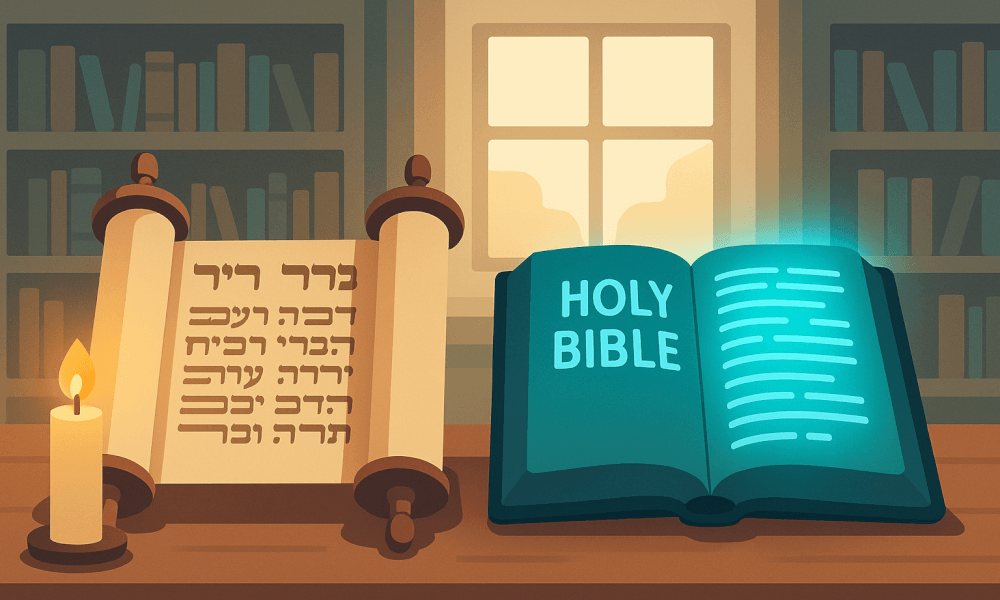
Digital platforms like Bible Hub now offer side-by-side comparison of translations, including original Hebrew Bible texts with commentaries. For those interested in Torah vs Bible vs Quran comparisons, or exploring differences between the Tanakh vs Bible, numerous scholarly resources are now available online.
For scholarly exploration, I recommend “Jewish Concepts of Scripture: A Comparative Introduction,” which examines interpretive traditions throughout history. The Jewish Theological Seminary offers exceptional courses on contextual understanding of Hebrew scriptures, including the relationship between Torah and Talmud.
Most exciting are the emerging AI tools for text analysis—they’re helping us discover linguistic patterns and thematic connections across traditions that previous generations of scholars might have missed. These digital archives and AI-powered search capabilities make comparative study of sacred texts of Judaism and Christianity more accessible than ever, allowing us to engage with the books of the Bible and Torah scrolls in ways our ancestors could never have imagined.
Exploring the Torah vs Bible gives us a powerful window into not only our religious heritage but also ourselves. Have you ever sat in synagogue as the Torah scroll passed by, feeling both awed and humbled? I’ve had that moment—seeing the ornate silver adornments glittering softly against flickering candlelight, hearing whispered blessings from my community around me.
On the other hand, I remember friends clutching well-worn bibles at Sunday services, finding comfort in verses translated through generations into familiar English phrases.
Let’s embrace these differences with curiosity and respect—not just for scholarship’s sake but because life’s wisdom often resides precisely within those spaces between similarity and variation. After all, isn’t it our endless quest for understanding—and a few friendly debates—that makes faith journeys so meaningful (and occasionally entertaining)?
Keep digging deeper; who knows what fascinating insights you’ll uncover next!